
Direct answer
WM ESS configurations pair 1–2 kW output with 2–4 kWh listed battery energy. Confirm the SKU, electrical configuration, installation requirements and order documents.
Before ordering wall-mounted energy storage, establish whether the product is a battery module or an integrated system, then check output power, battery energy, electrical configuration and installation requirements. A wall-mounted enclosure describes its physical arrangement; it does not establish compatibility with the customer’s loads or existing equipment.
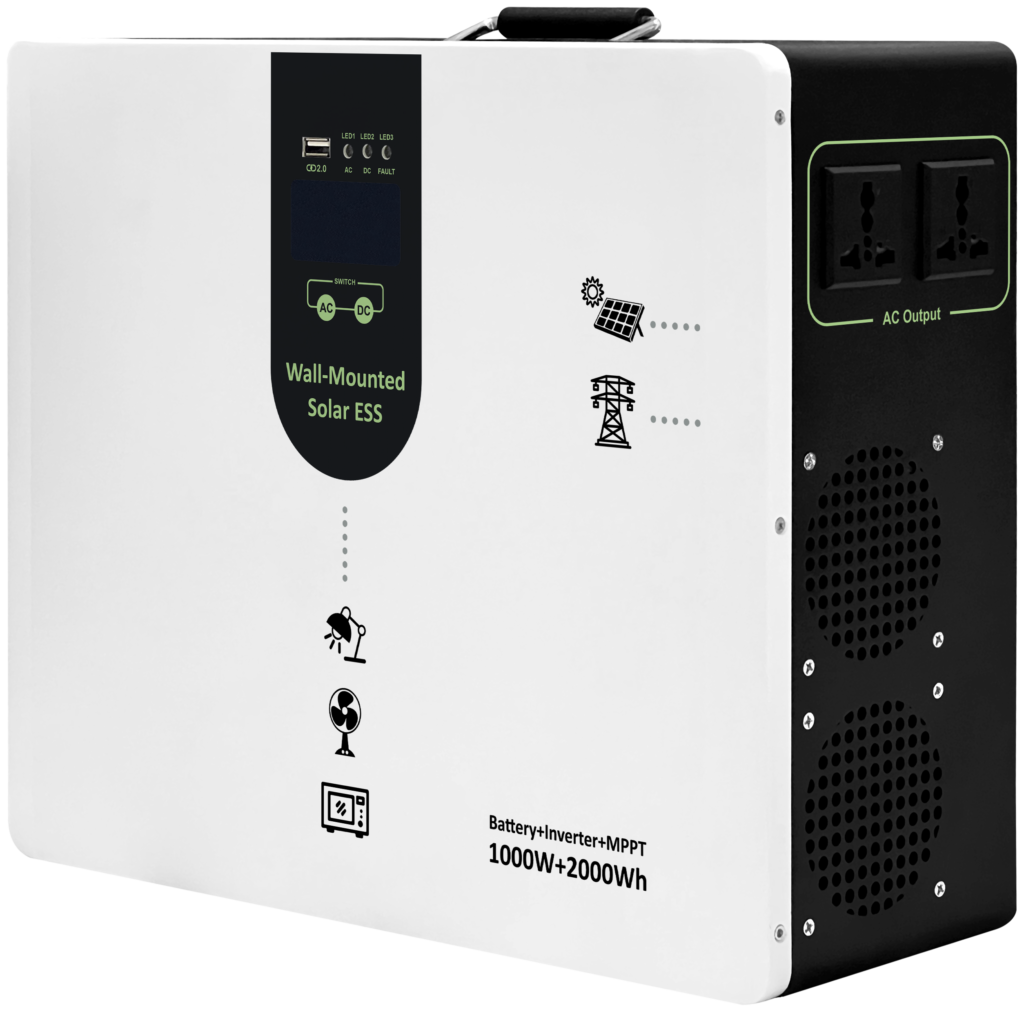
The KEZHUN WM ESS models discussed here are listed as wall-mounted solar energy storage systems with both inverter-output and battery-energy specifications. Distributors should evaluate the complete configuration rather than compare them with a battery-only product using the model number alone.
Separate rated output from battery energy
| SKU | Rated inverter output | Listed battery energy |
|---|---|---|
| WM-ESS-1000 | 1000 W | 2 kWh |
| WM-ESS-1500 | 1500 W | 3 kWh |
| WM-ESS-2000 | 2000 W | 4 kWh |
Output power helps define how much equipment can run together. Battery energy is an input to the operating-time assessment. A larger energy figure does not remove the need to check peak load, starting demand and usable energy.
Review the individual specifications and photographs for WM-ESS-1000, WM-ESS-1500 and WM-ESS-2000. These listed energy values are not a claim of guaranteed AC energy or a tested backup duration.
Confirm the destination’s electrical configuration
Put the required AC voltage, frequency and outlet or connection arrangement in the enquiry. Match those requirements to the exact SKU and the configuration written in the quotation. A family name or similar enclosure is not enough to assume that every model has the same electrical output.
If the customer already has solar equipment, provide its model and electrical specifications. The review should establish what is included in the WM system, which inputs and outputs are intended to be used, and whether the proposed combination is supported. Do not assume that a wall-mounted integrated system is a direct replacement for a standalone battery connected to another inverter.
Prepare a load list that represents the intended use
For each essential appliance, record quantity, running power, hours of use and any known starting demand. State which appliances will operate together. A distributor selling to several applications should keep separate load lists rather than use one generic runtime claim across all customers.
For an illustrative calculation with clearly stated assumptions, see our guide to sizing a backup battery from a load list; the sample values are not a runtime guarantee for the WM ESS models.
Also describe the backup objective: maintaining selected lights and communications, operating an appliance group during an outage, or another defined use. Include the expected recharge opportunity. A system serving short interruptions with regular charging faces a different energy requirement from one expected to operate through a long period without replenishment.
Check the installation and service space
Ask for the exact model’s installation instructions, dimensions, weight, mounting requirements and environmental limits. The installer needs to assess the supporting wall, access, ventilation and cable routing against those instructions. Product photographs are useful for identifying the enclosure and interfaces, but they do not replace an installation plan.
Discuss service access as well as the space occupied by the product. A unit that fits a location may still be difficult to inspect or maintain there. Do not promise outdoor suitability, an enclosure protection rating or a particular mounting method unless it is supported by the exact configuration’s documents.
Agree the documents and support process before ordering
| Information to confirm | Why it matters |
|---|---|
| Exact SKU and configuration | Keeps the quotation, product label and supplied documents aligned. |
| Model-specific technical data | Supports the load, charging and installation review. |
| Required product documents | Allows the team to review the named model and document scope for the destination. |
| Quantity, packaging and delivery destination | Provides inputs for MOQ, packing and freight confirmation. |
| Warranty and after-sales process | Clarifies the agreed coverage, evidence needed for support and service responsibility. |
Record the confirmed terms in the quotation and order documents. Custom branding, accessory inclusion, expansion capability and warranty duration should be requested and confirmed individually; they are not established merely by the product family name.
Use the residential energy storage range to compare the available system types. For a useful first review, send one target application and a complete requirement list rather than only asking for the largest battery.
Planning a distributor order? Request a configuration and wholesale quotation with the WM SKU, quantity, destination, required electrical output and load list. KEZHUN will review MOQ, configuration and pricing with the enquiry.